
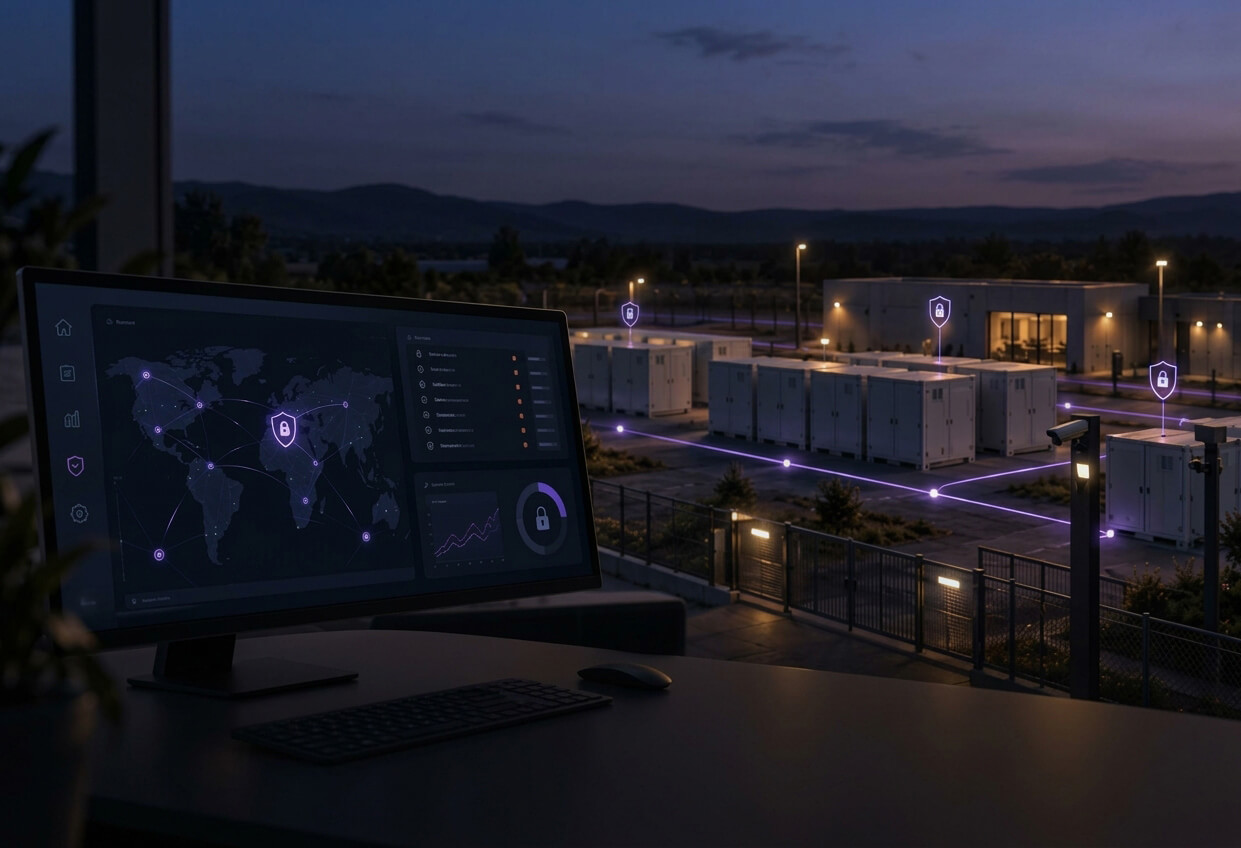
Well-informed decisions
Most mistakes are made before a decision is taken. Before a project gets underway, it is worth having a clear understanding of the implications of the control level, cyber security and early technical decisions.
Control
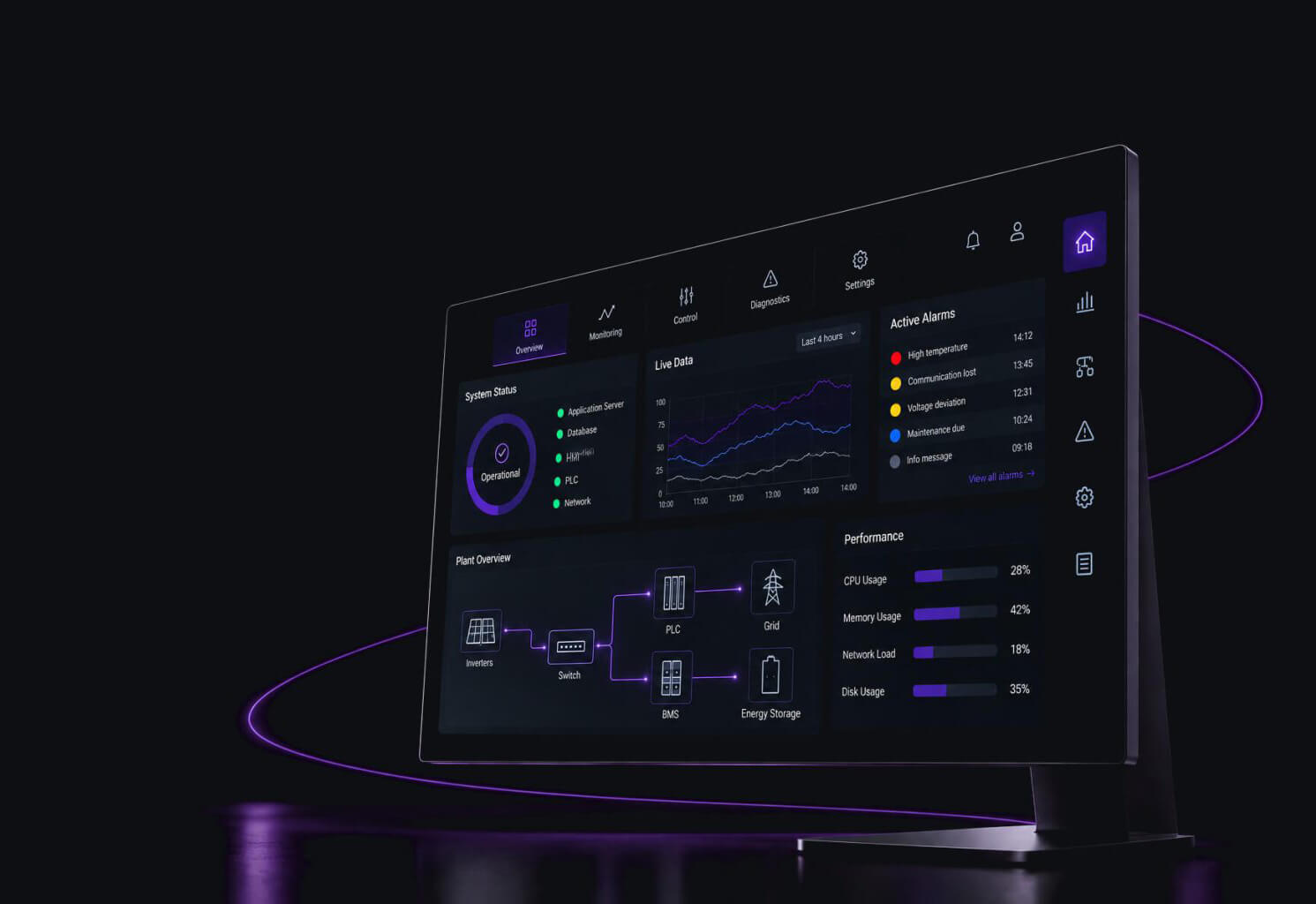
NR SCADA
Utility-scale supervisory control and data acquisition system with project-specific configuration: POI-level power station control, full redundancy, IEC 61850 communication, aFRR and FCR capability.
Cybersecurity
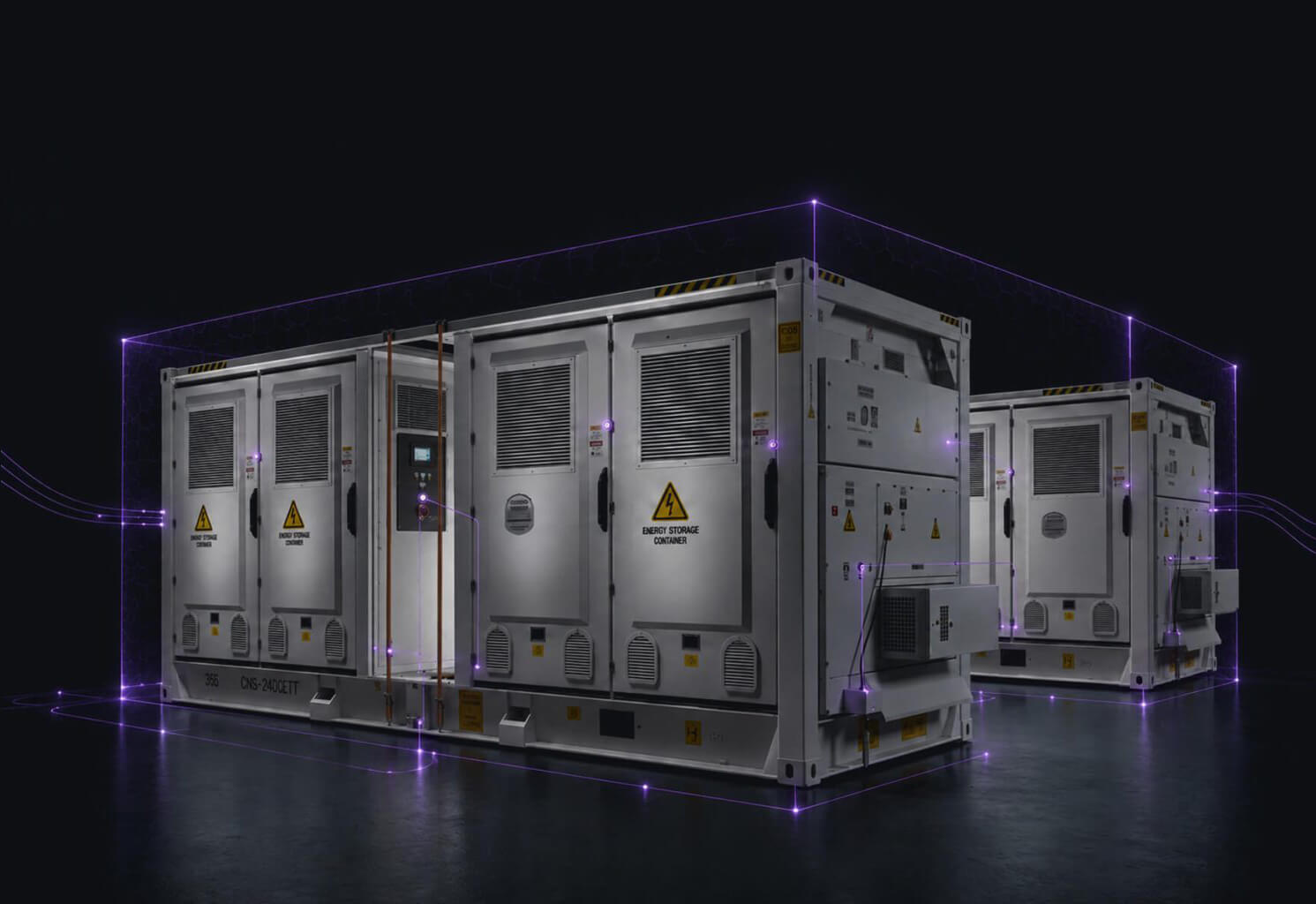
Cybersecurity is not an optional add-on license; it is an integral part of the control system.
Standards such as NIS-2, ISO 27001, and IEC 62443 apply directly to the control system. Consequently, we design protection within a unified architecture—extending from the field cabinet all the way to the central SCADA system.
- Industrial 4G router, IPSec VPN, VLAN, and firewall
- Intrusion Prevention and Detection Systems (IPS/IDS)
- Isolated data connections and two-factor authentication
- Zoning in accordance with IEC 62443 and comprehensive logging
Things to Know
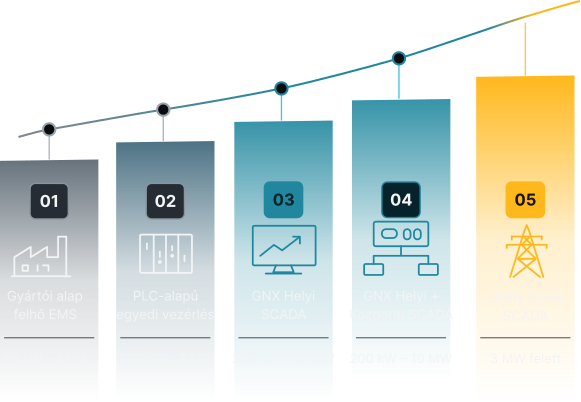
Which control level is right for your project?
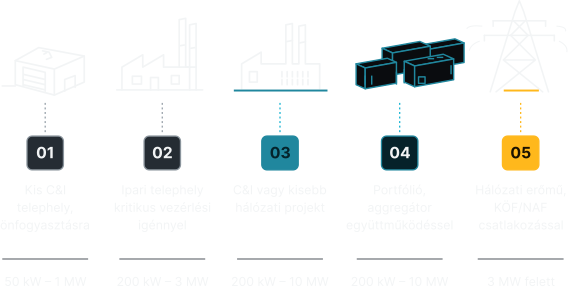
The choice depends on the project’s size and objectives. For small C&I (commercial and industrial) sites focused on self-consumption, a factory-supplied EMS (Energy Management System) is sufficient. Managing a portfolio or participating in aggregator schemes requires a central SCADA system. For projects exceeding 3 MW—especially those providing grid services—a utility-scale SCADA system is necessary.
When does it make sense to build a microgrid?
It makes sense when the projected cost of a power outage exceeds the capital and operational costs of the system. For critical infrastructure, the value of ensuring a continuous power supply typically outweighs the cost of the system itself.
Does it alert, or does it intervene?
Monitoring observes, while SCADA intervenes. This determines whether the system reacts automatically to an event within milliseconds, or waits hours for human intervention.
Cybersecurity in industrial environments
Protecting OT systems is not just a scaled-down version of IT security. It requires segmented networks, role-based access, and continuous monitoring—even during active operations.
Why are there no “off-the-shelf” solutions?
No two sites are ever the same. We design control systems based on the specific location, load, connection requirements, and business objectives—never by simply picking from a catalog.
Frequently Asked Questions
Based on predefined thresholds and rules, which the control logic continuously compares with real-time measurements.
The intervention is carried out by the local PLC with a response time of a few milliseconds.
The site continues to operate independently. Real-time control and protection functions, such as reverse power protection, run on the local PLC, whilst the local database continues to log data even when the connection is lost.
Access is controlled on a role-based basis, and all operations are logged. External access is only possible via an encrypted VPN connection with two-factor authentication; clients may be granted read-only access.
The solution is based on the IEC 62443 industrial cybersecurity standard and follows the principles of the NIS-2 Directive and ISO 27001. The detailed compliance framework is set out in the technical summary, which is available for download.
The intrusion detection and prevention system (IDS/IPS) continuously monitors for unusual patterns, such as access attempts from unknown devices, and immediately sends an alert to the monitoring team.
Both form part of a common architecture: control and protection are not simply added together as an afterthought, but are integrated from the very start of the design process. The GNX Smart Control Box combines the two in a single cabinet.
Yes. GNX solutions are based on a common data model, so upgrading is a matter of configuration and service, not reinstallation. With a closed, proprietary system, however, new control hardware and new logic are required.